Real-World Test Drive: Ather Rizta 3.5 kWh Range & Performance Review
Ather Konark EV real-world test covers 58.5 km on around 60% charge, with accurate range prediction, smooth performance and comfortable ride quality.
 Blog · Sep 4, 2026
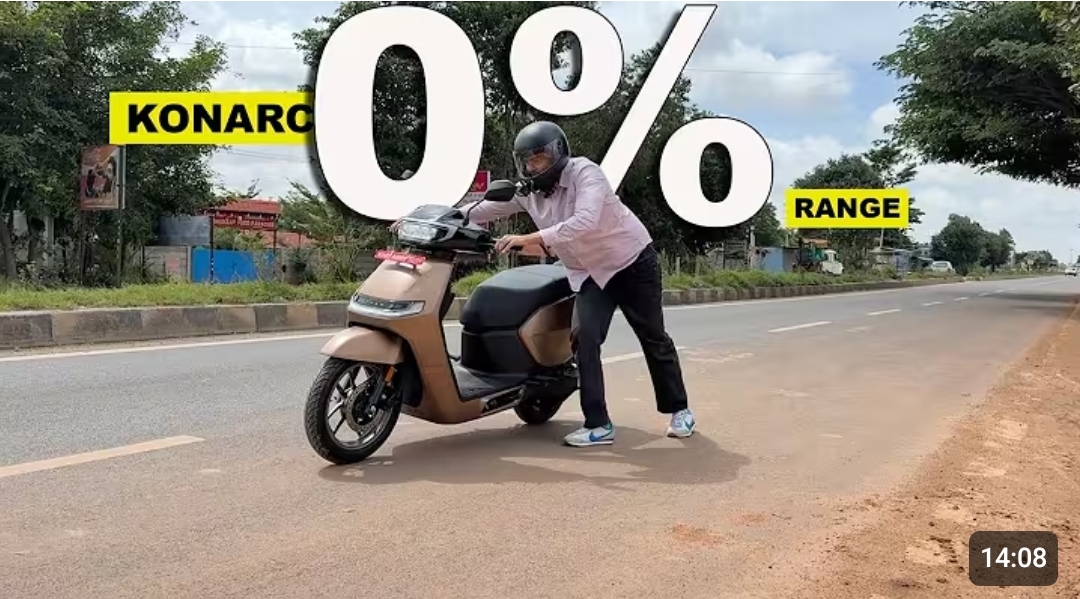
Anubhav set out on a real-world test ride of the Ather Konark EV to evaluate its practical performance, ride quality, and actual battery range in everyday city traffic. Riding with a passenger onboard, he pushed the scooter across mixed roads to see if its dashboard range estimates held up under continuous load. Throughout the ride, he tested everything from high-speed acceleration and emergency braking stability to suspension comfort over deep potholes. He also tested the scooter’s limits by riding it down to a completely drained battery to check how it handles low-power states and flyover inclines. Ultimately, his experience revealed a remarkably comfortable, silent, and stable scooter with an impressively accurate range predictor that delivers on its promises.
Riding the Ather Konark EV: A Real-World Test & First Impressions
He took the new Ather Konark EV out on the road to test how it holds up in everyday traffic rather than relying solely on ideal test specs. Ather launched this scooter in two main variants—the S and the Z—with three battery options available: 2.1 kWh, 2.7 kWh, and 3.5 kWh.
- 2.1 kWh Version: Costs ₹1,00,000 (Ex-showroom) with a claimed range of 100 km.
- 2.7 kWh Version: Costs ₹1,23,000 (Ex-showroom) with a claimed range of 125 km.
- 3.5 kWh Version: Costs ₹1,45,000 (Ex-showroom) with a claimed range of 160 km.
Delivery for the S variant began around September, while the Z variant arrives closer to January. He tested the top-spec 3.5 kWh version on real roads with two people onboard, navigating through typical city traffic, open stretches, and busy local streets.
Setting Up the Range Test
When he started the ride, the battery was sitting at around 65% charge. The screen displayed estimated ranges based on riding modes:
- Smart Eco Mode: 87 km
- Eco Mode: 73 km
- Power Mode: 67 km
Rather than babying the throttle in Eco mode to save battery, he reset the trip meter to zero and decided to ride it purely in Power Mode to see how accurately the range dropped under normal, day-to-day riding conditions.
Riding Modes and Power Delivery
The motor across all battery setups delivers 16 Nm of torque. The 2.1 kWh battery produces 5.3 bhp, whereas the 2.7 kWh and 3.5 kWh versions push out 6.3 bhp.
- Eco & Smart Eco: These modes strictly focus on efficiency. He noticed that pinning the throttle in Eco mode on a single-lane road simply won’t give enough power to overtake moving traffic.
- Power Mode: Switching to Power Mode is necessary if you need to pull past another vehicle quickly. Across all battery versions, the scooter tops out at 70 km/h.
He felt the power delivery at speeds around 50–55 km/h was smooth and linear. While it doesn’t give the aggressive, instant “punch” of the performance-focused 450x, it picks up speed effortlessly.
Suspension and Highway Stability
He found the chassis and suspension balance to be one of the scooter’s strongest highlights:
- Wheel & Travel: It features a 14-inch front wheel and an impressive 100 mm of rear suspension travel.
- Pothole Handling: The suspension isn’t overly soft or wallowy, nor is it uncomfortably stiff. It strikes a balance that keeps the scooter planted and stable at higher speeds, while taking harsh potholes in stride without jarring the riders.
Display & Space Comfort
- Screen Visibility: Even under direct midday sunlight with a dark dashboard theme, he experienced no glare issues; all information remained crisp and legible.
- Pillion Comfort: Thanks to having the longest length and wheelbase in its segment, riding with a second person felt spacious. The pillion passenger had plenty of room without pushing up against the rider.
Early Range Results
After completing an 11.9 km stretch in Power Mode with a passenger, the dashboard range dropped accurately from 67 km down to 55 km. He noted that the range predictor is precise and mirrors real-world battery consumption closely.
Practicality and Footboard Space
He noted that the seat space on the scooter feels comfortable, and the front footboard area offers ample room. There is sufficient space on the floorboard to place small luggage or utility items while commuting.
Using the screen controls while riding allows checking information like the odometer reading or current trip details, though basic controls primarily switch through displays rather than deep menu configurations.
High-Speed Testing and Top Speed Limits
He put the scooter into Power Mode from a standstill to test its flat-out acceleration and top speed:
- 0 to Top Speed: The scooter pulls briskly off the line without hesitation and accelerates steadily through 55 km/h and 60 km/h.
- Top Speed Cap: It hits its top speed limit of 70 km/h cleanly. The scooter holds steady at 70 km/h and does not push past this speed ceiling unless going down a steep incline.
Suspension Performance & Emergency Braking
He brought the scooter over uneven patches at speed to evaluate its comfort and braking feedback:
- Suspension Feel: The 100 mm rear suspension travel works effectively. It keeps the vehicle stable at high speeds without skidding or making the rider feel like they might lose control.
- Braking Test (Non-ABS): The model he tested does not feature ABS (which is reserved for higher-tier variants like the Z). He tested emergency braking from 70 km/h:
- Using only the rear drum brake still provided strong, efficient stopping power.
- Applying both front and rear brakes simultaneously brought the scooter to a rapid, controlled stop without losing stability or balance.
Silent Operation vs. Ather 450 Series
One distinct feature he highlighted was motor noise. Unlike the Ather 450 series—which produces a signature whine from its belt drive under hard acceleration—this scooter runs almost entirely silent even at top speed. There is virtually no belt or motor noise while riding.
Range Depletion, Eco Mode Drop, and Flyover Test
He pushed the scooter continuously in Power Mode to see how it handles low-battery states:
- Power Mode Hold: The scooter maintained full acceleration in Power Mode down to the very last few kilometers of estimated range.
- Automatic Mode Shift: When the range dropped down to 3–4 km, the scooter automatically deactivated Power Mode and forced itself into Eco Mode to save power.
- Incline Handling on Low Battery: With the scooter forced into Eco Mode and carrying two passengers up a flyover incline, acceleration slowed down significantly. While overtaking on single-lane roads in this state wasn’t possible, it still had enough power to climb up the slope smoothly without stalling.
Riding Beyond 0 km Range
Even after the dashboard range hit 0 km, the scooter did not cut off immediately:
- The trip meter reached 57.8 km total on a partial charge (starting from 65%).
- Carrying two passengers, it successfully climbed a final slope on 0 km remaining range.
- The scooter finally came to a complete stop after covering 58.5 km in total, at which point twisting the throttle no longer engaged the motor.
Build, Ergonomics, and Final Thoughts
He summarized the key design highlights after completing the test:
- Wheels & Ground Clearance: Features 14-inch front alloy wheels, rear alloy wheels, and ample ground clearance for daily use.
- Design & Comfort: Includes full LED tail lamps, a supportive backrest, and a wide, spacious seat that offers high overall comfort for daily city rides.
Lighting, Boot Space, and Visibility
He noted that while he couldn’t thoroughly test the headlight throw during daytime conditions, it seemed adequate for general night rides.
- Boot Opening & Capacity: Opening the boot requires using the physical key ignition. The under-seat storage offers around 31 to 34 liters of space across all variants (2.1 kWh, 2.7 kWh, and 3.5 kWh). However, there is no boot lamp provided inside the compartment.
- Rear-View Mirrors: He praised the wide rear-view mirror design, which provides a clear and expansive view of trailing traffic without obstruction.
Final Mileage & Complete Discharge Test
To push the battery down to 0% and verify dashboard accuracy, he rode the scooter continuously until the motor cut out completely:
- Distance Covered on 60% Charge: The scooter covered 58.5 km on roughly a 60% battery charge.
- Final Walk: Since the motor finally died close to his destination, he only had to push the scooter manually for about 200 meters to complete the test.
Real-World Range Estimates vs. Company Claims
He drew his final conclusions on battery health and range predictions:
- Dashboard Accuracy: The dashboard does not show a raw percentage readout; instead, it displays estimated range. He found that the range listed on the display directly translates to real-world kilometers on the road—it delivers exactly what it predicts.
- Extrapolated 100% Range:
- Power Mode: Yields around 100 km of actual usable distance on a full charge.
- Eco Mode: Delivers over 120 km of real-world city range.
- Smooth / Gentle Riding: He estimated that riding conservatively in Eco or Smart Eco mode can easily yield up to 140 km of range (against the official IDC claim of 160–161 km).
He concluded that the scooter provides reliable range feedback and doesn’t suffer from sudden battery drops, making it a dependable daily commuter.