
India’s First Ethanol-Powered EV Fast Charger Launched: 150kW Off-Grid Charging Without Electricity Grid – Here’s How It Works
 Blog · Aug 4, 2026
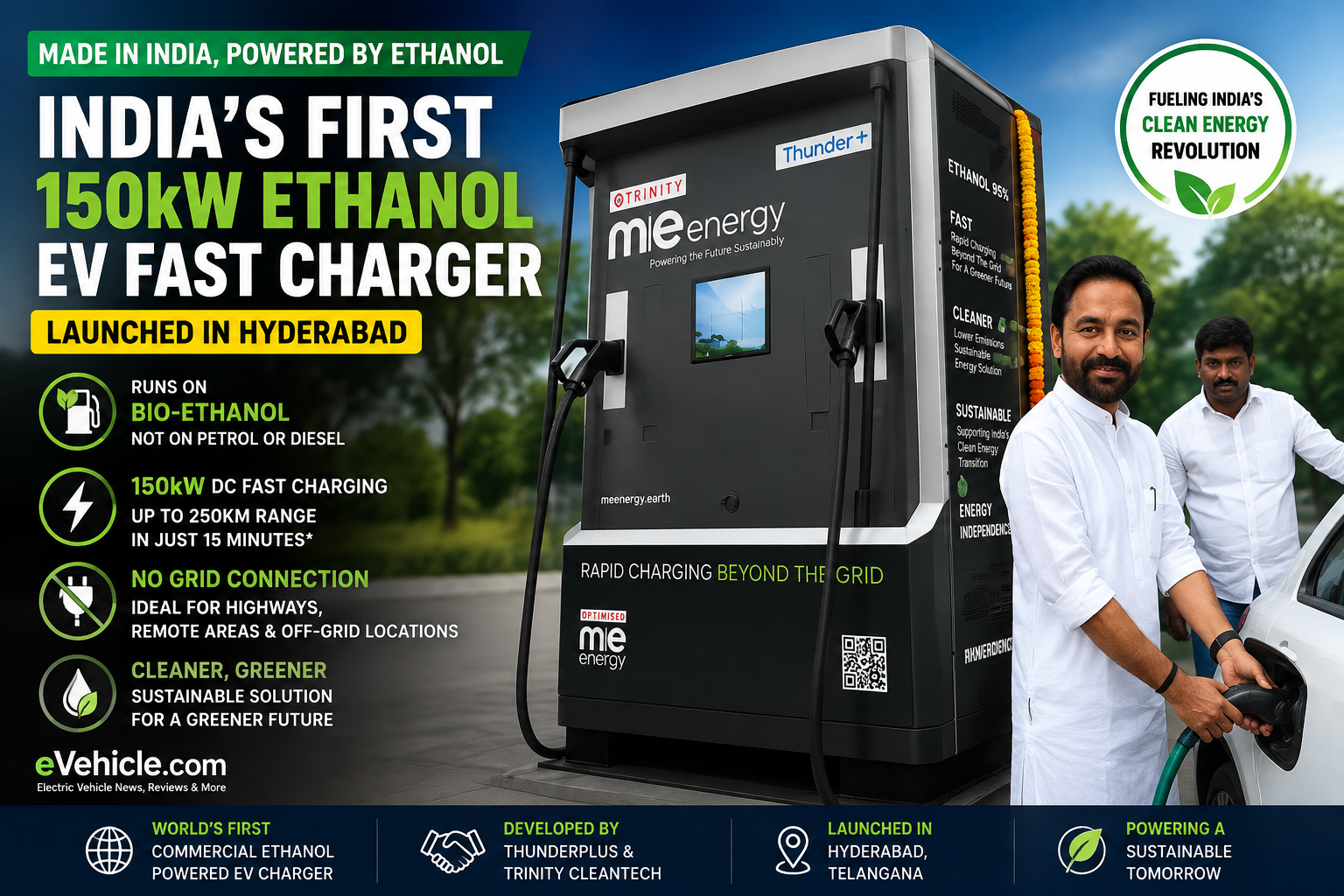
Hyderabad, India: India’s electric vehicle charging ecosystem has taken a major leap forward with the launch of the country’s first 150kW bio-ethanol-powered off-grid DC fast EV charger. The innovative charging solution was unveiled in Hyderabad, Telangana, by Union Minister for Coal and Mines G. Kishan Reddy.
The charger has been introduced by ThunderPlus in partnership with Trinity Cleantech, bringing Germany’s me energy Rapid Charger 150 technology to India. The companies describe it as the world’s first commercial 150kW ethanol-powered off-grid DC fast EV charger.
Unlike conventional charging stations, this system does not require a connection to the electricity grid. Instead, it generates electricity on-site using bio-ethanol, making it suitable for highways, remote regions, mining sites, construction projects, disaster relief areas, temporary EV charging stations, and locations with limited grid capacity.
At present, the companies have announced plans to deploy the technology in phases across India, although they have not disclosed the total number of chargers that will be installed.
How Does an Ethanol EV Charger Work?
One of the biggest misconceptions is that ethanol is poured into the electric vehicle. That is not how the system works.
The EV still runs entirely on electricity. Ethanol is only used as a fuel to generate electricity inside the charging unit.
The charging process works as follows:
- Fuel-grade bio-ethanol is filled into the charger’s fuel tank.
- An integrated power-generation system converts ethanol into electricity.
- Advanced power electronics convert the generated electricity into 150kW DC fast charging.
- The electricity is then delivered directly to the EV’s battery.
In simple terms, the charger acts as a mobile power station, producing electricity wherever grid power is unavailable.
Does It Use Petrol or Diesel?
According to the official information released by the companies, no.
The charger is designed to operate entirely on bio-ethanol and does not rely on petrol or diesel during normal operation. Its primary purpose is to replace diesel generator-powered charging solutions in off-grid locations.
Up to 250 km of Range in Just 15 Minutes
The companies claim that the 150kW DC fast charger can provide enough energy for up to 250 km of driving range in approximately 15 minutes, depending on the vehicle’s battery size, charging capability, and ambient conditions.
Is Ethanol Charging Cheaper Than Grid Electricity?
Not necessarily.
Where grid electricity is available, conventional EV charging remains the most economical option.
A general cost comparison is as follows:
- Grid electricity: Lowest charging cost
- Ethanol-powered charging: Higher than grid electricity but suitable for off-grid applications
- Petrol/Diesel generator-powered charging: Typically the most expensive option
This means the ethanol-powered charger is not intended to replace grid-based charging. Instead, it offers a practical fast-charging solution in locations where grid infrastructure is unavailable or insufficient.
Is Ethanol Easily Available in India?
India has emerged as one of the world’s leading ethanol producers. Bio-ethanol is primarily produced from sugarcane molasses, corn, broken rice, and other agricultural feedstocks.
However, 100% fuel-grade ethanol is generally not available at regular fuel stations. Commercial operators procure ethanol in bulk through authorized industrial suppliers.
How Is Ethanol Produced?
Bio-ethanol is manufactured through a fermentation process.
Sugar-rich feedstocks such as sugarcane molasses or starch-rich crops like corn are first converted into fermentable sugars. Yeast then ferments these sugars into ethanol, which is purified through distillation before being used as a transportation fuel or industrial energy source.
eVehicle.com Verdict
As India’s EV market expands rapidly, charging infrastructure in remote areas remains a major challenge. Ethanol-powered off-grid fast chargers could bridge this gap by enabling rapid EV charging without requiring expensive grid connections.
While grid-connected charging stations will continue to be the most cost-effective solution in cities, ethanol-powered charging could become a game-changing technology for highways, mining operations, logistics hubs, rural regions, and temporary charging installations, helping accelerate EV adoption while reducing dependence on diesel generators.

