Why “One Shell, Two Cells” Cars Could Be the Next Big Thing — And Why They Might Not
 Blog · Jun 8, 2026
The electric vehicle industry is constantly searching for ways to reduce costs, improve battery life, and make EVs more practical. CATL’s newly revealed “One Shell, Two Cells” battery architecture could be one of the most important developments in this direction.
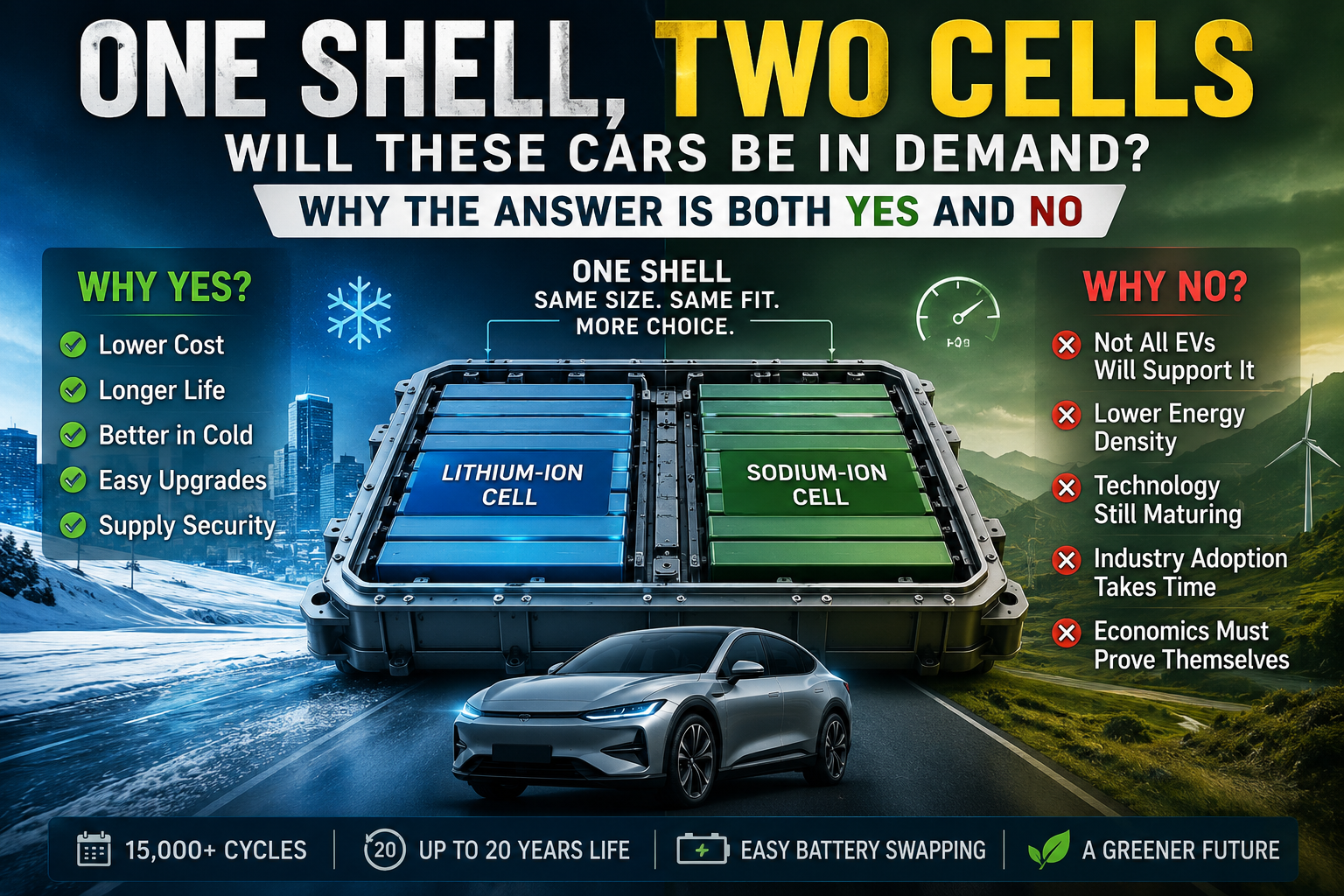
The concept is simple: a single battery pack design (shell) can accommodate different battery chemistries, including lithium-ion and sodium-ion cells. This flexibility could transform how EVs are designed, manufactured, and upgraded.
Why the Answer Is Yes
1. Future-Proof EVs
Consumers may no longer be locked into a single battery chemistry. A vehicle purchased today with a lithium-ion battery could potentially benefit from future sodium-ion technology without requiring a completely new vehicle platform.
2. Lower Vehicle Costs
Automakers can use the same battery pack structure across multiple vehicle models and battery chemistries, reducing manufacturing complexity and costs.
3. Easier Battery Swapping
A standardized battery shell makes battery-swapping networks more practical. Drivers could receive different battery chemistries in the same vehicle depending on availability and driving needs.
4. Faster Adoption of Sodium-Ion Batteries
Sodium is abundant, inexpensive, and widely available. As sodium-ion batteries mature, automakers can adopt them more quickly because they can fit into existing battery architectures.
5. Better Supply Chain Security
The world currently depends heavily on lithium and critical minerals. Sodium-based batteries provide an alternative that reduces dependence on limited resources.
Why the Answer Is No
1. Not All EVs Will Support It
Most EVs on the road today were not designed for multiple battery chemistries. Retrofitting existing vehicles could be expensive or technically difficult.
2. Different Battery Characteristics
Lithium-ion and sodium-ion batteries have different voltage profiles, energy densities, and charging behaviors. Supporting both requires advanced battery management systems.
3. Range Concerns
Current sodium-ion batteries generally offer lower energy density than lithium-ion batteries. For long-range premium EVs, lithium may remain the preferred choice for years.
4. Industry Adoption Takes Time
Even if the technology works perfectly, global automakers need years to redesign platforms, validate safety standards, and scale production.
5. Economics Must Prove Themselves
The concept is promising, but consumers ultimately care about vehicle price, range, charging speed, and reliability. The market will decide whether the benefits justify the transition.
The Bottom Line
“One Shell, Two Cells” is not just a battery innovation—it is a platform innovation. If adopted widely, it could allow future EVs to switch between lithium-ion and sodium-ion batteries with minimal redesign, creating more flexibility for automakers and consumers alike.
Will these vehicles be in demand?
The answer is likely yes if automakers can deliver lower prices, longer battery life, and easier upgrades. However, widespread adoption will depend on whether sodium-ion technology continues to improve and whether manufacturers embrace standardized battery architectures.
For the EV industry, this could be the beginning of a future where buying a new battery is easier than buying a new car.
Related Articles